

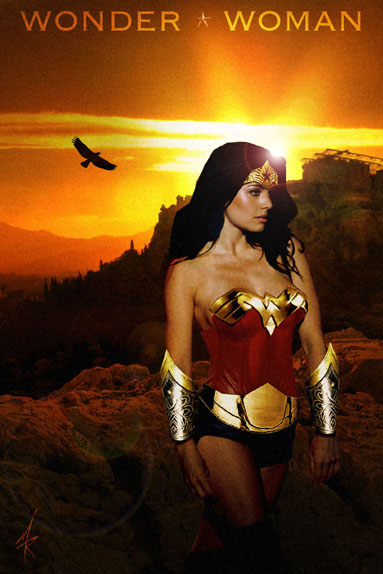
For the last three weeks, I busied myself reading a book assigned to my America’s Themes and Dreams class. I must say, for a non-fiction book, this book was a great read. The book I’m talking about is The Secret History of Wonder Woman by Jill Lepore. I never knew that Wonder Woman has been around since the 1940’s. She disappeared for a little while and even had a meek side to her, but now I understand why she is a stronger Amazonian than Zena the Princess Warrior.
Wonder Woman got her start from William Moulton Marston who was the first person to attempt to create a lie detecting device though he never received any credit for his experiments, that may have been due to his own follies. Marston was born in 1893 and grew up in the Moulton Castle, Newburyport, Massachusetts. He was a student at Harvard during the Women’s Suffrage Movement and attended a lecture by Emmeline Pankhurst. “Marston was fascinated; he was thrilled; he was distracted.” (Lepore 11)
And so, life’s stage was set in motion for the actions of William Moulton Marston who became the creator of Wonder Woman about 30 years later.


Secret Identities of Women Hidden Behind the Lies of a Man
The charade of secret identities began with Margaret Sanger and Ethel Byrne. Ethel wanted more in life than to be a mother and attributed her oldest sister’s death with having had too many children of her own even though it was said that Anne Higgins died of tuberculosis. Ethel struggled to be a mother but her daughter, Olive Byrne, was a very fussy baby. Apparently, the child cried a lot which is why when Olive was two, Ethel decided there was more in life than being a mother and left her two children with her husband’s parents and disappeared from their lives. (Lepore 82)
About this time Ethel’s lies began so she could pretend to be someone she was not all because she wanted to be a nurse like her older sister Margaret. So, she lied about her marital status so she could train as a nurse at Mount Sinai Hospital. To be a student at this hospital, a woman needed to be single. At a young age, Olive noticed the lies of her mother, Ethel, and also for her grandparents too. Her grandparents lied by saying Ethel was dead. But Olive knew better. She knew her grandmother lied to her. ““Deceit comes easy to the Irish,” Olive Byrne liked to say.” (Lepore 83)
The character of Wonder Woman was created to reflect the lives of the women in William Moulton Marston’s life. Wonder Woman’s identity was to be hidden in the same manner the lifestyle of Marston, Olive, Holloway, Huntley, and the children were to be hidden. ““Either hide this well or destroy it. It was the family motto.”” (Lepore 319)
The adults lied about who the children’s mother and fathers were and the living arrangements during their entire lifetimes. Even to their death, they were reluctant to tell anyone about how Marston had taken two wives and not just one and how they all lived happily ever after underneath one roof. They were living secret lives by hiding behind different identities to explain their living situation. Their identities became so confusing toward the end even to them that later in life when relating stories to their grandchildren sometimes Olive Byrne could be heard whispering, ““Those stories were about me.”” (Lepore 321)
Margaret Sanger encouraged the charade to continue when Ethel Byrne became involved in the Birth Control Movement. Ethel was arrested for distributing birth control paraphernalia to women which was against the law at that time. She was sent to prison. While there Ethel went on a hunger strike. “Byrne’s inspiration was Emmeline Pankhurst.” (92) Margaret feared her sister would die in prison from the hunger strike. She pled with the governor of New York to pardon Ethel so she would not die. The Governor agreed but only on one condition. Margaret had to promise that Ethel would not break the law from that time on. (Lepore 95)
The day after Ethel was pardoned Sanger was found guilty of providing birth control products and information just like Ethel. The only difference was, Sanger did not take part in a hunger strike. She did her time and went on her way. (Lepore 96)
When Olive was sixteen, she visited her mother who was living in New York under strange living arrangements. Olive knew her mother was sleeping with someone even though they weren’t married. When she inquired about the arrangement, Ethel laughed and told her, ““Margaret was known to invent ‘nice covers’ for circumstances that she thought might become a matter of scandal at stake, embarrassing to herself.”” (Lepore 99)
The living arrangement of Ethel, Margaret, and Bob Parker might have taught Olive that this sort of arrangement was acceptable if the details were kept from anyone’s knowledge. Hence where her secret identity began along with Holloway, Marston, and Huntley because Holloway wanted to be a career woman and have children. Marston wanted to have two wives, and Olive wanted to be part of a family. “They’d find a way to explain it, to hide it. The arrangement would be their secret. No one else need ever know.” (Lepore 123)
Olive Byrne wore bracelets on her wrists which gave Marston the idea to have Wonder Woman wear those same bracelets that could fend off bullets. The bracelets became part of Wonder Woman’s identity just as Olive began creating her own fictional story to explain her pregnancy situation. Olive created William K. Richard on November 21, 1928, when she married a man who didn’t exist and became Olive Richard, her new identity. When her children began asking about their father, she told them he had died because of gas from the war and had suffered lung problems. No photos of him existed. “Byrne and Donn’s father was William Moulton Marston.” (Lepore 143)
Olive began keeping diaries which she used secret codes. “Olive believed the truth was best kept secret: in particular, she didn’t want her children to know about it, ever.” (147) She had to create layers of deception which was why she created William K. Richard. Whenever she wrote about Holloway’s husband, she referred to Marston as “W.M.M.” and when she wrote about the father of her sons she referred to him as “R” or “Ri,” for “Richard.” (Lepore 147)
Batman and Superman comic characters were popular when Wonder Woman was created. They both had secret identities. So, didn’t Wonder Woman. Her identity was Princess Diana who became Diana Prince, a secretary for the U.S. military intelligence.
Writers tend to write about what they know most. Marston knew about lie detecting and deception. He created the very first model of the lie detector machine but never was credited for his work outside of the credits he pitched to the world. Trouble began for Marston January 1922. “Marston was charged with two crimes: using the mails in a scheme to defraud, and aiding and abetting in the concealment of assets from the trustee in the United Dress Goods bankruptcy.” (74) He was no stranger to lies and deception and aided in his ability to write the Wonder Woman stories. Marston also based the story on the women in his life who were all strong women involved in the woman’s movement. Even today, Wonder Woman makes her appearance every time Woman’s Rights makes a resurgence in the political atmosphere such as happened during the 1960’s and 70’s and is happening again today with the recent release in the movie theaters of Wonder Woman that debuted June 2, 2017. (Lepore)
The world of today is much different from that of the 1930’s and 40’s. Women’s Liberation has made leaps and bounds. From women holding careers and maintaining a family lifestyle to same-sex couples living the lifestyle of traditional couples and a woman’s ability to choose when to have children and how many children she wants to have. Back when Holloway struggled to have a career and a family at the same time she wanted both and but, to do this Olive needed to become part of the game plan. In today’s world, there are live in Nannies, nursery care, and babysitters while soccer mom not only manages to look after the family but she also doubles with her own career as well. Housework has been delegated to the older children, housekeeping services or shared by the couple. Back in the 1950’s, men were reluctant to fold a towel or mop the floor while nowadays he too shares multiple roles such as his wife. Not only have women become liberated by birth control, but they are also free to choose a career path or family life, or better yet – both.
Works Cited
Lepore, Jill. The Secret History of Wonder Woman. New York: Vintage Books A Division Penguin Random House LLC, 2015. Print.


 Linda Nelson
You must be logged in to post a comment.